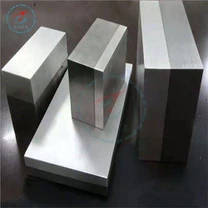
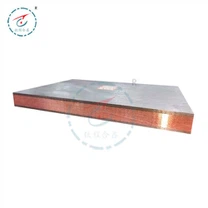
Titanium-steel clad plate combines the advantages of titanium alloy and steel, not only has good corrosion resistance, but also has high strength, and the cost is greatly reduced. It has a wide range of application prospects in petrochemical, marine, aerospace, and other fields. Welding Technology is one of the key technologies in the manufacture of titanium-steel clad plate components. Titanium-steel clad plates are mainly manufactured by explosive welding or hot rolling welding methods, and the preparation process is relatively mature. It is a titanium-steel clad plate manufacturing technology with potential application prospects. Due to the large difference in physical and metallurgical properties of titanium and steel, its welding is difficult, which is a typical dissimilar metal welding problem. From the requirements of process adaptability From the point of view, the fusion welding process is the most suitable welding process.
At present, the welding of titanium steel clad plates is mainly based on lap welding, butt welding, and transition welding of clad plates. The welding process of lap welding and butt welding of titanium plates developed earlier. From the perspective of the base metal, the welding process belongs to the same The welding process is simple and easy to use, and it is a relatively mature joint form. However, the components using lap welding of titanium plates have obvious intermediate gaps and cover plate bulges, the structure is bloated, and the bearing capacity is limited; on this basis, the development of The butt welding process of titanium plate is adopted, which overcomes the problems of unreasonable joint structure and low bearing capacity, and improves the adaptability of welding structure of titanium steel clad plate; the welding of transition layer of the clad plate is a composite plate developed based on the welding process principle of dissimilar steel clad plate. The plate welding process is the most promising welding method in engineering, and it is also the welding method that faces the most welding metallurgical problems.
The main problem faced by the direct welding of titanium and steel is that the formation of Ti-Fe brittle compounds in the weld makes it impossible to form a defect-free joint. The solution is to use Ni, Cu, Nb, V, etc., which are compatible with Ti and Fe. The elements are used for transition welding to avoid or weaken the formation of Ti-Fe brittle compounds. The welding of titanium-steel clad plates also faces the same problem. For this purpose, two methods of non-transition welding and metal transition welding have been developed for the welding of titanium-steel clad plates.
At present, the non-transition welding of titanium-steel clad plates, that is, lap welding and butt welding of titanium cover plates, is the main welding method in the early stage of the development of titanium-steel clad plates. The process is simple and convenient, and the brittleness of titanium and iron in the weld is effectively avoided. Compounds have been widely used in electric power, petrochemical, and other fields that require low welding quality. However, the problem of unwelded welded joints has always been insurmountable, and the reliability of welded structures may be reduced under service environmental conditions. risk, which limits the application of important products with high-reliability requirements.
Baoji Taicheng Metal Co.,Ltd is a metal clad plate manufacturer, which can provide you with all kinds of customized metal clad plates. We have a professional technical team and a perfect after-sales service team. You are welcome to inquire and look forward to cooperating with you!